 English
Views: 0 Author: Site Editor Publish Time: 2026-09-09 Origin: Site


Are you building an off-grid refrigeration system? Choosing the right components is the absolute difference between a reliable food storage solution and a setup that rapidly drains your battery bank overnight.
Selecting a cooling unit isn't just about picking a famous brand. You must perfectly align your electrical voltage, your specific cooling duty, and the appropriate refrigerant. Miss one of these variables, and your system will fail. In this guide, we break down the technical specifications that actually matter from an engineering perspective. By the end, you will understand exactly how to navigate 12V, 24V, and R134a applications. You will learn to engineer a system that thrives in the harshest mobile environments.
Voltage Matters: A 12-volt system provides straightforward plug-and-play compatibility for standard automotive setups. Conversely, a 24-volt architecture delivers superior electrical efficiency and requires thinner wiring, making it optimal for heavy-duty trucks and large-scale solar arrays.
Duty Cycle Dictates Temperature: The internal mechanics of low back pressure units are engineered strictly for deep freezing. In contrast, medium/high back pressure units are calibrated to handle standard refrigeration and ambient air conditioning tasks.
Refrigerant Standard: R134a remains the established gold standard for mobile cooling. It offers a proven balance of thermodynamic stability, non-flammability, and widespread global availability for field maintenance.
System Synergy: Failing to match your voltage, cooling duty, or refrigerant type inevitably results in catastrophic system failure. It leads to excessive power consumption and severe underperformance in high-ambient temperatures.
Over the past few years, the off-grid and mobile transport sectors have experienced a massive technological shift. Fleet operators and overland builders are rapidly abandoning traditional absorption fridges and bulky AC inverters. The baseline electrical demand in modern mobile setups has skyrocketed. Users now expect to run induction cooktops, satellite internet dishes, and reliable cooling simultaneously without idling their engines.
Consequently, the industry is moving aggressively toward native direct current (DC) cooling architectures. We are seeing a distinct trend where builders prioritize thermal efficiency, anti-vibration durability, and ultra-low amp draw. This push is rendering older, power-hungry cooling methods obsolete. Purpose-built, variable-speed DC units have officially become the new baseline for mobile engineering.
Understanding the foundational mechanics of your equipment is the first step in designing a reliable off-grid cooling system. A direct current unit operates using a brushless motor. It draws power directly from a battery bank. This fundamentally differs from traditional alternating current (AC) household appliances. AC units require a continuous grid connection or a bulky power inverter to function.
Think of this component as the mechanical heart of any mobile refrigeration compressor system. Its primary job is circulating refrigerant gas. It compresses the vapor to increase its pressure and temperature. Then, it pushes that high-pressure vapor through condenser coils to release trapped heat into the surrounding air.
For battery-powered setups—such as remote solar cabins, overland camper vans, and sailing vessels—DC variable-speed technology is virtually mandatory. Using a standard AC fridge with an inverter introduces an immediate energy loss of 10% to 15%. This loss happens right out of the gate due to the electrical conversion process. Purpose-built DC models eliminate this inefficiency entirely.
Furthermore, mobile environments are brutal. They involve constant movement, intense vibrations, and uneven terrain. Picture driving down a heavily corrugated dirt road in Baja or navigating steep ocean swells. A standard household compressor will quickly fail if operated at an angle. Its internal lubricating oil shifts away from critical moving parts, causing the motor to seize. High-quality DC units, however, are specifically engineered with anti-tilt mechanisms. They safely operate at angles up to 30 degrees while ensuring continuous internal lubrication.
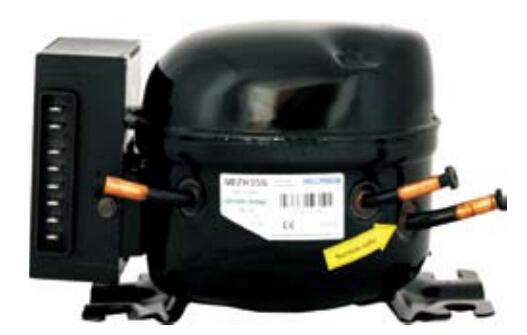
Selecting the correct voltage is a critical engineering decision. It dictates your battery configuration, wire gauge requirements, and overall thermal efficiency. As you evaluate your build, you must align your choice with your planned electrical foundation.
The 12-volt platform is the undisputed standard for light-to-medium mobile applications. Its primary advantage lies in universal compatibility. Most cars, vans, and standard recreational vehicles operate on a 12V chassis battery. Integrating a 12V DC compressor into these existing systems is a straightforward process. It rarely requires complex step-down converters.
This widespread adoption means replacement parts are easy to source. It is ideal for smaller portable coolers and weekend camper builds. However, there is a notable drawback: higher amperage draw. According to Ohm’s Law, a 60-watt unit running at 12 volts draws 5 amps. Over long cable runs, this higher current increases the risk of voltage drop. To prevent the system's low-voltage cut-off from triggering prematurely, you must invest in thicker, more expensive copper wiring, such as 8 AWG or 10 AWG.
To minimize resistive heat losses across extensive cable runs, the commercial industry is migrating heavily toward 24-volt ecosystems. A 24-volt unit pulls exactly half the amperage of its 12-volt counterpart for the exact same wattage. That same 60-watt motor only draws 2.5 amps at 24 volts.
This lower current drastically reduces heat generation within the wiring infrastructure. Builders can safely use thinner, lighter, and more cost-effective cables over longer distances. It is undoubtedly the superior choice for heavy-duty trucks, large marine vessels, and dedicated high-capacity solar arrays.
Specification Metric | 12V DC Architecture | 24V DC Architecture |
|---|---|---|
Amperage Draw (60W Load) | 5.0 Amps | 2.5 Amps |
Recommended Wire Gauge (15ft run) | 8 AWG (Thicker/Heavier) | 12 AWG (Thinner/Lighter) |
Voltage Drop Risk over Distance | High (Requires strict wire sizing) | Low (More forgiving on long runs) |
Best Application Scenarios | Camper vans, SUVs, small portable coolers | Semi-trucks, marine vessels, off-grid cabins |
Running a strict 24-volt appliance on a 12-volt battery bank requires a high-quality DC-to-DC step-up converter. While technically feasible, this introduces a new point of mechanical failure and minor efficiency losses.
Modern engineering has largely solved this dilemma. The most reliable solution today is purchasing an auto-switching, dual-voltage unit (12/24V). These intelligent systems feature integrated electronic control modules. They automatically detect the incoming voltage and adjust the motor's operation accordingly. This eliminates the risk of voltage mismatch entirely. It also provides maximum flexibility if you decide to upgrade your battery bank in the future.
When engineering a mobile cooling system, voltage is only one part of the equation. The "duty" refers to the specific back pressure and evaporation temperature range the equipment is mechanically designed to handle. Selecting the wrong duty cycle will inevitably lead to systemic inefficiency, continuous motor strain, and premature equipment failure.
An LBP compressor is engineered specifically for low evaporation temperatures. It typically operates within a stringent range of -35°C to -10°C (-31°F to 14°F). At these extreme temperatures, the refrigerant gas is at a lower pressure and lower density. The internal valving, displacement, and motor torque characteristics are specifically calibrated to pull this low-density vapor efficiently.
These units belong strictly in deep freezers, commercial mobile ice makers, and medical transport coolers that require sub-zero internal temperatures. A common, yet fatal, engineering mistake is installing a low back pressure unit in a standard refrigerator meant to keep food at 4°C (39°F). Because it is designed for low-pressure vapor, exposing it to the higher suction pressures of a standard fridge causes the returning gas temperatures to spike. The motor will over-amp. This leads to severe short-cycling, rapid overheating, and eventual mechanical seizure.
Conversely, an MHBP unit is designed for higher evaporation temperatures, generally spanning from -15°C to +15°C (5°F to 59°F). The refrigerant gas at these temperatures is much denser. To handle the increased mass flow rate, these units feature a completely different valve design and motor winding configuration.
This is the correct choice for standard food refrigerators, beverage coolers, and small cabin air conditioning units where the target internal temperature remains above freezing. Just as you shouldn't use a freezer unit for a fridge, an MHBP model cannot achieve the ultra-low temperatures required for deep freezing. It will run continuously in a futile attempt to reach a setpoint it was never mechanically designed to achieve, draining your battery bank in the process.
The choice of refrigerant directly impacts the thermodynamic efficiency, safety, and serviceability of your build. In the realm of mobile cooling, specific chemical properties dictate performance under extreme stress.
Tetrafluoroethane, commonly known as R134a, possesses exceptional thermodynamic properties for small-scale, direct-current systems. With a boiling point of -26.3°C (-15.3°F), it absorbs heat rapidly as it evaporates inside the confined spaces of a mobile evaporator plate. When paired with a variable-speed motor, the operating pressures of an R134a compressor align perfectly with modern torque curves. This ensures a high Coefficient of Performance (COP) even when powered by fluctuating battery voltages. It allows heat to be expelled efficiently through the condenser fins even when outside air temperatures exceed 40°C (104°F).
While domestic household appliances have almost entirely adopted R600a (isobutane) driven by strict environmental regulations, the mobile sector faces a different reality. Engineering consensus dictates that the intense vibrations, potential collision risks, and confined spaces of overlanding vehicles and marine vessels make highly flammable hydrocarbons a significant liability.
This is exactly why R134a remains the steadfast choice for off-grid mobility. Classified as an A1 refrigerant by ASHRAE, it is completely non-toxic and non-flammable. If a copper line fractures due to severe road vibration or a hull impact, a leak poses absolutely no fire hazard. Furthermore, it is globally ubiquitous. Whether you are traversing the Pan-American Highway or sailing across the Mediterranean, automotive and marine technicians worldwide carry this specific gas. This ensures field maintenance remains affordable and accessible anywhere.
Navigating technical spec sheets can quickly become overwhelming. By following a systematic, empirical framework, you can cut through the marketing noise. You will be able to purchase the exact hardware required for your specific custom build based on real-world engineering standards.
Before looking at cooling capacities, clearly define your electrical foundation. If you are running a standard 12V AGM or Lithium iron phosphate (LiFePO4) battery bank, prioritize a 12-volt unit to avoid conversion losses. If your system utilizes a 24V solar array, strictly select a 24-volt unit to capitalize on lower amperage. Whenever possible, opt for an auto-sensing dual-voltage model to future-proof your investment against future electrical upgrades.
Determine the exact purpose of your insulated box. Are you building a heavily insulated chest freezer to store deep-sea fish catches at -20°C? If so, strictly source a low back pressure (LBP) unit. Are you outfitting a standard upright fridge for weekend camping produce at 3°C? A medium back pressure (MHBP) unit is mandatory. Never mix these applications.
Your equipment must have enough thermal displacement to overcome the heat ingress of your specific box. An undersized motor will run at a 100% duty cycle, consuming excessive power. An oversized unit will short-cycle, causing unnecessary wear.
Calculate the required capacity based on the cubic volume of your fridge and the thickness of your polyurethane insulation. As a practical baseline for a well-insulated box operating in a 32°C (90°F) ambient environment:
A small 50-liter (1.7 cubic feet) cooler typically requires a compressor with 2.0cc to 2.5cc displacement, yielding approximately 35W to 45W of cooling capacity.
A larger 150-liter (5.3 cubic feet) upright marine fridge demands a larger 4.3cc displacement unit, pushing 80W to 110W to maintain safe temperatures during hot summer days.
Always verify the manufacturer's ASHRAE testing data to match the output to your target evaporation temperature.
Mobile environments offer incredibly limited space. Verify the physical dimensions and the mounting footprint to ensure the unit fits within your designated compartment. Crucially, ensure adequate ventilation around the condenser fan to dissipate heat.
Equally important is your wiring infrastructure. DC systems are highly susceptible to voltage drop over distance. If your battery is 15 feet away from the fridge on a 12-volt system, you must use at least 8 AWG marine-grade tinned copper wire. Failing to size your wires correctly is the number one cause of low-voltage errors in DIY builds.
The versatility of modern variable-speed technology allows these units to be deployed across a wide range of demanding environments. Understanding how these technical specifications translate to real-world scenarios helps clarify the exact requirements for your project.
Historically, recreational vehicles relied heavily on 3-way absorption refrigerators that ran on propane, AC, or DC power. While versatile on paper, absorption fridges are notoriously inefficient. They are highly sensitive to being parked off-level and struggle severely to cool when ambient temperatures spike. Upgrading to a dedicated compressor-driven fridge transforms the travel experience. It cools down in a fraction of the time, operates flawlessly on steep mountain inclines, and easily maintains safe food temperatures regardless of external heat waves.
Marine environments are arguably the most punishing for refrigeration hardware. Boat hulls trap heat, and ambient temperatures in engine rooms or galleys can easily reach stifling levels. Equipment must endure constant pounding from waves and high ambient humidity. Marine builders rely heavily on robust systems equipped with corrosion-resistant coatings and vibration-dampening mounts. Because power generation on a sailboat is often limited to small solar arrays or wind generators, the ultra-low amp draw of a 24V DC unit becomes absolutely critical. It maintains frozen provisions during long ocean crossings without firing up the diesel generator.
Long-haul truck drivers require reliable in-cab refrigeration to store fresh food and reduce reliance on expensive truck stop meals. Because modern commercial trucks utilize 24-volt electrical architectures, installing a native 24-volt system is the logical choice. These setups allow drivers to keep their food cold overnight without idling the engine. This significantly reduces diesel consumption, lowers emissions, and ensures compliance with strict anti-idling laws in various jurisdictions.
Building a reliable mobile refrigeration system is an exercise in precision engineering. The secret to a flawless off-grid setup lies in perfectly aligning your electrical voltage, your specific thermal duty cycle, and the appropriate safety-rated refrigerant.
Taking the time to evaluate your power bank and calculate your exact cooling requirements prevents the frustration of dead batteries and spoiled provisions. By strictly adhering to the technical specifications outlined in this guide, you guarantee that your custom cooling solution will operate with maximum efficiency, regardless of how far off the grid your travels take you.
Ready to engineer your next off-grid refrigeration project? Ensure you select components built for the harshest environments. Explore high-performance, anti-tilt DC compressors and find the exact specifications for your custom build at Retekool today.
While the total wattage consumed to perform a specific cooling task is nearly identical between the two, 24-volt systems are technically more efficient in their actual power delivery. Because a 24-volt system operates at twice the voltage, it draws exactly half the amperage to yield the same wattage. This lower amperage significantly reduces resistive heat loss within the wiring infrastructure. It results in better overall electrical efficiency and allows for thinner cables.
A low back pressure unit is mechanically designed to process low-density refrigerant vapor at sub-zero temperatures. If applied to a standard refrigerator operating at higher, above-freezing temperatures, the returning vapor is much denser. This forces the motor to work far beyond its designed torque limits, leading to excessive amperage draw, rapid overheating, and a severely shortened mechanical lifespan.
No, this is highly discouraged. Solar panels produce highly variable voltage depending on cloud cover, shading, and sun angle. This constant fluctuation will immediately trigger the electronic control unit to shut down due to voltage instability. The cooling unit must always be wired to a stable battery bank, which acts as a buffer and is continually recharged by the solar panels via a dedicated MPPT or PWM charge controller.
Absolutely. While the commercial household industry is exploring alternative refrigerants with lower Global Warming Potential, R134a remains the most practical, safe, and reliable choice for mobile applications today. It offers excellent thermodynamic efficiency and is completely non-flammable—a critical safety factor in vehicles and boats. Moreover, the necessary parts, gauges, and refrigerant gas are globally accessible for field maintenance anywhere in the world.
This entirely depends on your battery's usable amp-hour (Ah) rating, the ambient temperature, and the compressor's duty cycle. For example, a highly efficient 50-liter fridge running a modern DC unit might draw about 1.5 to 2.0 amp-hours. Over a 24-hour period, it will consume roughly 35 to 50 amps. A standard 100Ah Lithium (LiFePO4) battery, which allows for near 100% depth of discharge, could run this fridge comfortably for about two days without any solar or alternator recharge.
You can, but it is highly inefficient for off-grid applications. Household AC compressors are not designed to withstand the vibrations and tilted angles of mobile environments, leading to premature mechanical failure. Additionally, running an inverter to convert your battery's DC power to AC power introduces an immediate 10% to 15% efficiency loss. A purpose-built native DC unit eliminates this power waste and is physically built to survive harsh road and marine conditions.


