 English
Views: 0 Author: Site Editor Publish Time: 2026-10-14 Origin: Site


Imagine walking into your facility on a Monday morning only to find a pallet of premium pharmaceuticals or fresh produce completely ruined. Guessing your cooling capacity does not just jeopardize inventory. It spikes energy bills and accelerates equipment wear. As a refrigeration engineer who has spent years troubleshooting iced-up coils and burnt-out compressors, I can tell you that precision is everything. In this post, you will learn the exact factors, calculations, and equipment considerations required for proper cold room sizing.
Accurate sizing requires moving beyond simple square-footage rules of thumb and utilizing precise thermal load calculations.
Primary factors dictate your specific needs, including room dimensions, insulation quality, product heat load, ambient temperature, door usage frequency, and internal heat sources.
Choosing the right equipment design is just as crucial as hitting the target cooling capacity.
Oversizing an evaporator is highly detrimental, leading to short-cycling, excess humidity, and higher operational costs.
Large-scale commercial storage facilities require specialized zoning and airflow considerations compared to standard walk-in boxes.
When field technicians discuss sizing in the context of commercial refrigeration, they are not merely referring to the physical dimensions of the metal casing. Sizing refers to the precise cooling capacity of the equipment. We typically measure this in British Thermal Units per hour, Kilowatts, or Tons of Refrigeration. Achieving the correct capacity is a fundamental engineering requirement that dictates the operational success of your entire facility.
From a broader industry perspective, recent market analyses highlight a massive pivot driven by stringent energy regulations and the global phase-down of high-GWP, or Global Warming Potential, refrigerants. Facilities are rapidly adopting eco-friendly alternatives and IoT-driven climate controls to stay compliant. However, these smart systems are highly sensitive to mechanical baselines. If your evaporator is improperly sized, even the most advanced algorithms cannot compensate for the physical thermodynamic imbalance. This regulatory pressure means precise thermal sizing is no longer an operational luxury. It is a strict compliance and financial necessity.
Picture an undersized evaporator. It simply lacks the mechanical muscle to extract heat as fast as it bleeds through the insulated panels. Consequently, your compressor is forced into continuous operation in a futile attempt to reach the set point temperature. This relentless running leads to premature mechanical wear, drastically shortened equipment lifespans, and exorbitant electrical bills. More importantly, it compromises product safety. If the room temperature fluctuates above safe storage thresholds, perishable goods will spoil. This triggers massive financial losses and potential regulatory compliance issues.
A persistent misconception in our trade is that installing an oversized unit provides a comfortable safety net. In reality, oversizing is highly destructive. A unit with excessive capacity will drop the ambient air temperature much faster than it can remove airborne moisture. This phenomenon results in short-cycling, where the system rapidly turns on and off. Short-cycling prevents the evaporator coils from effectively dehumidifying the room. The lingering moisture eventually condenses and freezes on the fins. This leads to severe ice blockages, inconsistent climates, and potential compressor failure due to repetitive electrical surges.
In the commercial refrigeration sector, contractors generally rely on two distinct methods to determine equipment size. They either use traditional estimation or formal heat load calculations. For bottom-of-funnel purchasing decisions, distinguishing between the two is critical to protecting your capital investment.
Historically, some installers sized refrigeration units based purely on the floor area or total volume of the room. They allocated a generic number of BTUs per square foot. While this method is undeniably fast, it is fundamentally flawed for modern applications. It falsely assumes that all cold rooms operate under identical conditions. Relying on guesswork is a high-risk strategy that frequently yields mismatched equipment.
Conversely, the scientific approach involves calculating the Total Heat Load. This meticulous calculation measures the exact amount of thermal energy that must be extracted over a 24-hour cycle to maintain the target temperature. Engineers evaluate both sensible heat, which is temperature change, and latent heat, which is moisture change.
Methodology | Accuracy | Risk Profile | Best Application |
|---|---|---|---|
Rule of Thumb | Low to Moderate | High risk of short-cycling or continuous running | Preliminary budget estimates only |
Scientific Load Calculation | Pinpoint Precision | Minimal risk, ensures long equipment lifespan | Final equipment procurement and installation |
To execute an accurate thermal load calculation, refrigeration professionals dissect several distinct categories of heat transfer. Each element contributes uniquely to the total daily thermal burden. Missing even one of these variables will skew your final capacity requirements.
The physical footprint of the cold storage area serves as the foundation for all subsequent calculations. Beyond simply measuring floor space, ceiling height plays a massive role in determining volumetric capacity. A room boasting a ten-foot ceiling contains significantly more air mass to cool than one with an eight-foot ceiling. This total volume dictates the required cubic feet per minute of airflow the internal fans must generate to guarantee uniform temperature distribution.
Transmission Load refers to the ambient thermal energy that constantly bleeds into the space through the walls, ceiling, and floor. Because heat naturally gravitates toward colder environments, the rate of this transfer depends entirely on the R-value of your architectural materials. Modern facilities typically utilize high-density polyurethane panels. Superior insulation allows you to safely downsize your cooling equipment, saving upfront capital and long-term energy costs.
The inventory you place inside the space introduces a massive amount of heat. Specifically, this load is evaluated across three distinct phases. First, different materials retain different amounts of specific heat. Cooling a ton of water-dense beef demands significantly more energy than chilling dry packaged goods. Second, the temperature pull-down phase requires immense power. There is a stark contrast between maintaining a product at sub-zero temperatures and actively freezing an incoming warm shipment. Finally, biological respiration heat must be calculated. Fresh produce consumes oxygen and emits heat as it ripens, heavily impacting agricultural storage.
The environment immediately surrounding the insulated envelope directly influences the transmission load. A unit installed inside a climate-controlled food processing plant faces a relatively stable thermal challenge. By contrast, if the structure is erected outdoors in a region where summer temperatures regularly exceed extreme highs, the temperature differential becomes massive. The system must be engineered to conquer the absolute peak summer heat of your specific geographic location.
Every time a worker opens the heavy insulated door, chilled air spills out across the floor while warm ambient air rushes in near the ceiling. High-traffic commercial environments experience massive infiltration loads. This warm air introduces both sensible heat and latent moisture. Furthermore, everything that consumes energy inside the room adds to the thermal load. The human body generates significant watts of heat during physical labor. Forklifts, LED lighting, and even the fan motors of the evaporator itself generate heat during operation that must be neutralized.
Calculating the required capacity is only the first half of the engineering process. Once the precise thermal load is established, facility managers must match the specific physical design of the evaporator to the intended application. Utilizing a unit with the correct capacity rating but the wrong architectural design will inevitably lead to systemic failure.
Facilities operating blast freezers, ice cream storage, or medical deep-freeze rooms typically maintain internal temperatures ranging from negative eighteen to negative twenty-five degrees Celsius. In these harsh environments, airborne moisture rapidly condenses and freezes solid on the evaporator coils. To counteract this, specifying a specialized low temperature air cooler is absolutely mandatory.
From a practical standpoint, these sub-zero units are engineered with wider fin spacing, typically around 9.0 millimeters. This wide gap prevents rapid ice bridging across the aluminum fins. Additionally, they are equipped with robust stainless steel electric heater tubes or hot-gas defrost systems to actively melt ice accumulation during scheduled maintenance cycles.
For fresh produce, dairy preservation, and beverage cooling, target temperatures generally hover just above freezing. Because the risk of rapid solid ice formation is significantly lower in these zones, standard medium-temperature models are highly effective. The fin spacing on these units is usually tighter, ranging from 4.5 to 6.0 millimeters. This tighter spacing allows for a larger heat exchange surface area within a compact physical footprint. Defrosting in these environments can often be achieved simply by turning off the compressor and allowing the ambient fans to melt away light frost.
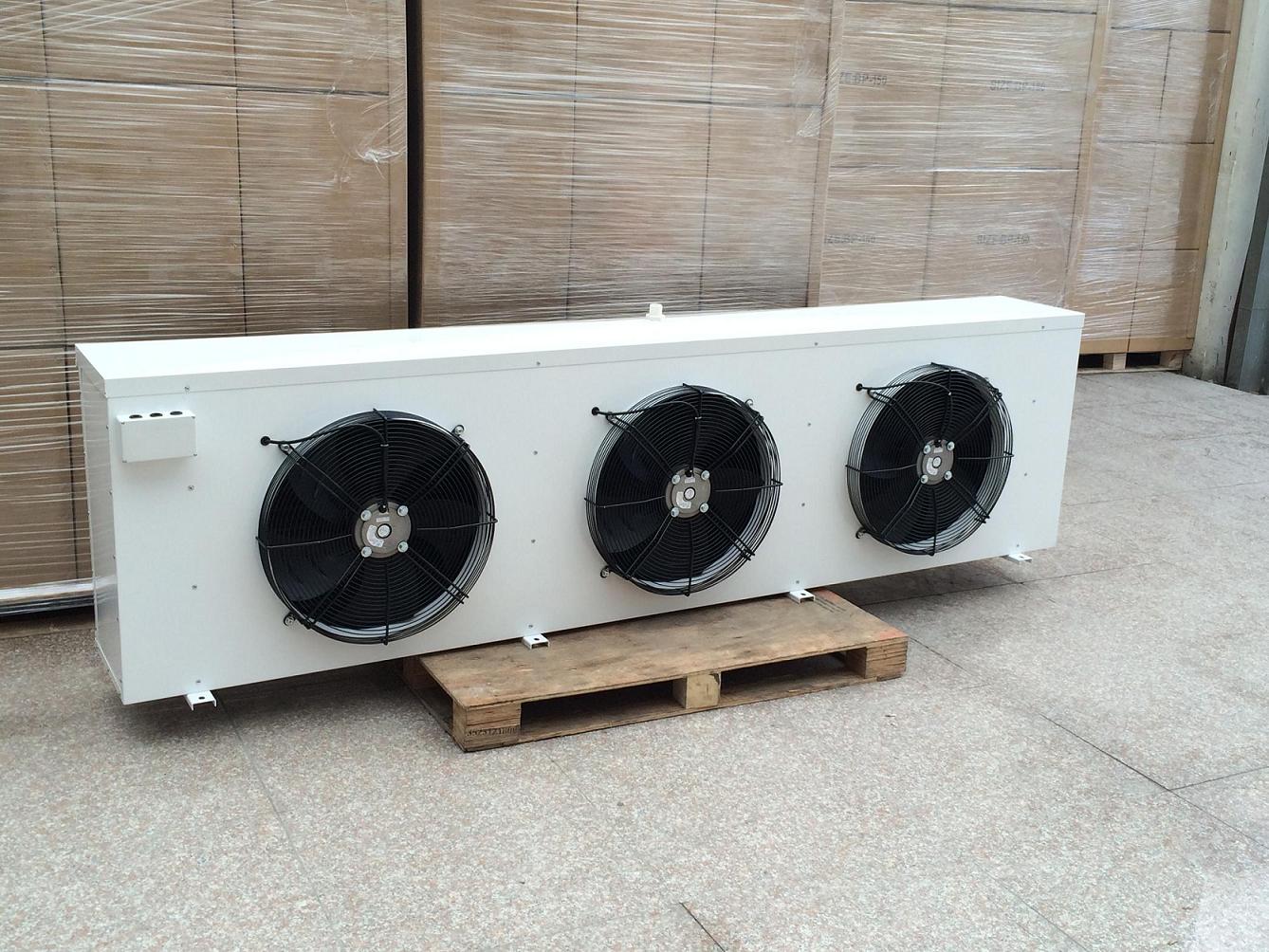
Beyond temperature parameters, the physical placement of the refrigeration equipment dictates the overall efficiency of the daily operation. Airflow dynamics play a critical role in maintaining uniform climates. For most commercial applications, installing a ceiling mounted unit cooler provides the most optimal balance of space utilization and thermodynamic efficiency.
In commercial warehousing, floor space equates directly to revenue. Floor-standing units consume valuable square footage that could otherwise be utilized for pallet racking. By adopting an overhead configuration, facility managers can maximize volumetric capacity. Thermodynamics dictates that cold air is denser than warm air, naturally causing it to sink. The internal external-rotor axial fans push high-velocity chilled air across the ceiling, which then gently cascades down over the stored inventory. This top-down distribution pattern is highly effective at eliminating dead zones.
When scaling operations from a standard restaurant walk-in to a massive industrial refrigerated warehouse, the sizing methodology must adapt. Large-scale facilities introduce complex aerodynamic challenges that simple calculations cannot solve.
In a sprawling commercial facility, the physical distance between the evaporator and the furthest wall can be vast. If the unit lacks sufficient fan power, the cold air will drop prematurely. Engineers must calculate the required air throw distance and select high-velocity axial fan motors capable of delivering the necessary airflow to reach the perimeter. Furthermore, relying on a single massive evaporator introduces a catastrophic single point of failure. Industry best practices dictate splitting the total required cooling capacity across multiple smaller units. This decentralized approach builds redundancy into the system. If one unit requires maintenance, the remaining units can temporarily sustain safe holding temperatures.
Even with access to advanced calculation software, critical errors frequently occur during the sizing phase. These miscalculations often stem from overlooking secondary thermal loads.
A prevalent mistake is failing to account for heat transmission through uninsulated concrete floors. The earth beneath a concrete slab acts as a massive thermal battery, and heat rising through the floor can add up to fifteen percent to the total transmission load. Similarly, mismatching the indoor evaporator with an inappropriately sized outdoor condensing unit will cripple the system. The entire refrigeration loop must be engineered cohesively. An undersized outdoor unit will prevent the room from reaching the target temperature, while an oversized one will strip excessive moisture from the air, severely dehydrating your stored products.
Proper cold room sizing is a meticulous engineering process that requires careful planning and a deep understanding of thermal dynamics. You must balance volumetric space, insulation quality, product characteristics, and daily operational usage with absolute accuracy.
Taking the time to execute comprehensive thermal load calculations prevents catastrophic product spoilage and significantly reduces excessive energy consumption over the lifespan of the equipment. Stop relying on outdated estimation methods and start building a highly efficient, sustainable facility.
We highly recommend consulting with certified refrigeration engineers to select the exact equipment tailored to your operational needs. Explore high-quality components, including the right commercial cold room cooler, to ensure long-term cooling success and protect your valuable inventory today.
Calculating the required capacity involves determining the Total Heat Load over a 24-hour period. This requires adding together four distinct metrics. You must calculate the Transmission Load, the Product Load, the Internal Load, and the Infiltration Load. Once the total daily thermal requirement is calculated, it is typically divided by a 16 to 18-hour runtime. This allows the compressor adequate time to cycle off and perform necessary defrosting safely.
While it may seem safer to buy a larger unit, oversizing is highly detrimental. An oversized system will cool the air down to the target temperature too rapidly and shut off before it has a chance to pull ambient humidity out of the air. This results in short-cycling, which causes severe wear on the compressor, spikes in electricity usage, and leaves the environment damp. Excess humidity leads to soggy cardboard packaging, mold growth, and unsafe storage conditions.
No. Using a standard model in a sub-zero environment will lead to immediate operational failure. Standard units have tightly packed fins designed for environments above freezing. In a freezer, ambient moisture will quickly bridge these tight gaps, turning the coil into a solid block of ice and completely blocking airflow. You must specify a unit featuring wide fin spacing and a built-in electric or hot-gas defrost system to manage ice accumulation safely.
Insulation is the primary barrier against external heat. Thicker insulation panels with a higher R-value drastically lower the Transmission Load. By minimizing the amount of ambient heat that leaks into the space, you reduce the total thermal burden on the refrigeration system. Consequently, investing in superior insulation allows you to specify a smaller, more energy-efficient unit, which lowers both your initial capital expenditure and your long-term monthly utility bills.
Fin spacing is critical for preventing ice blockages. For high-temperature preparation rooms above five degrees Celsius, a tight spacing of 4.5 millimeters is highly efficient. For medium-temperature storage hovering around freezing, 6.0 millimeters is standard. For deep-freeze applications dropping below negative eighteen degrees Celsius, you need a wide spacing of at least 9.0 millimeters to accommodate rapid frost buildup between defrost cycles.
Every time a door opens, heavy cold air escapes while warm, moisture-laden air enters. This is known as the infiltration load. In high-traffic distribution centers, frequent door openings can account for up to thirty percent of the total daily heat load. If your operation requires constant forklift access, you must significantly increase your calculated cooling capacity to quickly pull down the temperature of that invading warm air.


