 English

Views: 0 Author: Site Editor Publish Time: 2026-11-23 Origin: Site


In the world of commercial and industrial cooling, airflow efficiency is the critical margin between sustained food safety and rapid product spoilage. While axial and centrifugal blowers have long dominated standard HVAC systems, the cross flow fan—often known as a tangential fan—has carved out a highly specialized niche in modern cooling infrastructure. Understanding why these unique blowers are essential for temperature control begins with looking at how they optimize evaporator airflow within constrained spatial applications.
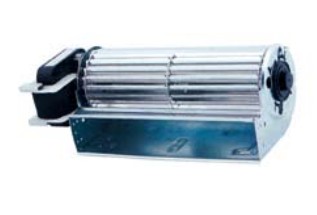
To grasp the utility of a tangential fan, one must look at its distinct mechanical profile. Unlike traditional devices that propel air parallel to the motor axis, this design uses an elongated, cylindrical impeller with forward-curved blades. As the impeller rotates, air is drawn in along the entire length of the drum, passes through an internal vortex, and is expelled on the opposite side.
This mechanism forces a 90-degree redirection of the air path. From an engineering perspective, this is a major advantage. It generates a continuous, two-dimensional planar jet of air rather than a focused, turbulent cone. Within the tight confines of a modern refrigeration unit, where cabinet depth is at a premium, this elongated geometry allows the blower to span the entire length of a cooling coil. This ensures that every inch of the heat exchanger is actively engaged in thermal transfer.
Thermal stratification and dead zones are frequent culprits behind premature inventory loss. When air circulation is suboptimal, dense cold air pools at the bottom, while warmer pockets persist near the top or corners of the enclosure. These hotspots not only accelerate microbial growth but also force the compressor to work harder, driving up energy costs.
Deploying a fan that delivers a broad, uniform sweep of air allows cooling systems to maintain a consistent velocity across the entire surface area of the evaporator. This flux is vital for system health. It prevents localized sections of the coil from dropping below the dew point too rapidly, which is a common trigger for problematic frost buildup. As the industry shifts toward higher energy-efficiency standards and stricter environmental regulations, the ability to maintain uniform temperatures without excessive energy draw has become a key design imperative for manufacturers.
Retail environments present a unique paradox: engineers must maximize product storage while concealing the heavy machinery required to keep those items fresh. Modern supermarket merchandisers demand sleek lines and maximum glass surface area, leaving minimal room for cooling infrastructure.
In this context, the low-profile form factor of these blowers is an indispensable asset. They can be mounted flush into the narrow plenums behind glass doors or within the top canopy of a case. By drawing air over concealed coils and pushing it down the rear wall, these fans create a robust cold wall effect. This laminar boundary layer effectively bathes the merchandise in chilled air without subjecting sensitive items to harsh, high-velocity gusts that often cause fresh produce or deli meats to dehydrate prematurely.
Beyond the internal architecture of the cabinet, managing temperature integrity in high-traffic zones remains a challenge. Open multi-deck displays and walk-in freezer entryways rely on an invisible barrier known as an air curtain to partition the conditioned interior from ambient shop temperatures.
The tangential fan is uniquely suited for this function. Because it produces a stable, high-velocity sheet of air with minimal internal turbulence, it creates a kinetic seal that effectively shears away infiltrating warm air. Industry trends reflect a clear move toward these high-efficiency barriers as facility managers look to minimize thermal leakage during door-opening cycles. By maintaining a clean, planar flow, these devices prevent the unwanted mixing of air masses, which directly reduces the duty cycle of the refrigeration compressor and prevents the humidity spikes that lead to icing.
When selecting components, engineers must carefully weigh the aerodynamic properties of different fan typologies. While axial fans are sufficient for general ventilation, they often fall short in specialized cooling due to their circular, focused output. In contrast, the tangential design distributes the workload across a longer impeller, allowing for the required volumetric flow rate at lower rotational speeds.
Lower RPMs do more than improve acoustic performance in quiet retail settings; they also minimize mechanical vibration, which protects the structural integrity of the display chassis. However, integration requires a rigorous look at system impedance. Since these fans generally offer lower static pressure capabilities compared to centrifugal blowers, the evaporator coil's fin density must be matched accordingly. If the aerodynamic resistance of the coil is too high, the fan may stall, leading to a decline in cooling efficiency.
Feature | Cross Flow Fan | Axial Fan |
|---|---|---|
Airflow Profile | Uniform, Planar Sheet | Focused, Turbulent Cone |
Space Efficiency | High (Slim/Elongated) | Moderate (Depth Required) |
Noise Levels | Generally Lower (at low RPM) | Variable (Higher at peak flow) |
Primary Application | Display Cases & Air Curtains | Condenser Cooling |
Even the most advanced cooling system will underperform if the mechanical components are not maintained. The primary threat to a tangential impeller is the gradual accumulation of particulates. Because the blades are closely spaced, they are magnets for dust and airborne debris. Even a thin layer of buildup can alter the fan’s aerodynamic profile, inducing imbalance and reducing the laminar nature of the discharge.
To sustain peak thermodynamic efficiency, facility teams should implement a proactive cleaning schedule—using soft brushing or compressed air to clear the impeller. Furthermore, in sub-zero environments, prioritize motor-fan assemblies equipped with low-temperature synthetic lubricants to prevent friction-related failures. Given that the cost of these components is minor compared to the value of the perishables they protect, a policy of regular, preventative inspection is the most cost-effective strategy for any modern retail operation.
Yes, in mechanical engineering and HVAC terminology, these terms are interchangeable. Both descriptors refer to a blower that pulls air in and expels it transversally across the full length of a rotating cylindrical impeller, resulting in a wide, flat airflow profile.
Not necessarily. Specialized cooling requires precise airflow patterns to ensure even heat exchange and to prevent localized frost buildup on the evaporator coils. A cross flow fan is frequently specified by engineers because its broad, uniform output profile is uniquely suited to ventilate the narrow, elongated chambers found in commercial equipment.
If your system experiences uneven cooling, frequent frost accumulation at the edges of the evaporator, or requires a very slim profile to maximize internal storage space, a tangential fan is likely the superior choice. Additionally, if your application requires an effective air curtain to mitigate energy loss at a doorway, this design is the industry standard.
Yes, they are highly efficient for their specific applications. By moving air across a wide surface area with minimal turbulence, they remove the need for restrictive internal ducting. This direct, uniform distribution reduces the load on the motor, often leading to lower overall energy consumption compared to forcing air through tight spaces with standard axial fans.
In standard commercial environments, preventative maintenance protocols dictate inspecting and cleaning the impeller every 3 to 6 months. Airborne dust combined with condensation can quickly cake onto the blades, which severely impedes airflow and forces the compressor to run longer, less efficient cycles.
For those looking to optimize their cooling infrastructure, selecting the right components is the first step toward long-term efficiency. If you are ready to upgrade your refrigeration performance or require technical guidance on specific blower applications, feel free to reach out to our team at Retekool for professional support and high-quality solutions.


