 English

Views: 0 Author: Site Editor Publish Time: 2026-11-04 Origin: Site


Selecting the right equipment is the single most critical decision when building or upgrading a small temperature-controlled facility. Field engineers often call this machinery the heart of the refrigeration system. Why? It dictates exactly how efficiently your storage maintains its target climate. It determines how well your inventory is preserved over time. A mismatched setup ruins perishable food, degrades temperature-sensitive pharmaceuticals, and causes daily spikes in energy bills.
Navigating technical specifications feels overwhelming for many business owners. Making an informed decision requires grasping basic thermodynamics and mechanical engineering principles. This guide simplifies the technical selection process. It helps you match the right equipment to your specific needs based on hard data and field-tested practices.
Looking at recent market shifts, the commercial refrigeration sector is moving rapidly toward compact, plug-and-play architectures. Stricter global energy regulations and rising utility costs force facility operators to abandon outdated rule-of-thumb sizing methods. Today, the industry trend leans heavily into precision load matching and low-GWP refrigerant compatibility. Accurate sizing is no longer just about keeping things cold. It is fundamentally about maximizing operational profitability and shrinking carbon footprints.
Capacity Matching: Calculate the total thermal heat load before finalizing your equipment. Oversizing or undersizing inevitably causes mechanical failure and inventory loss.
Refrigerant Efficiency: Traditional refrigerants remain a proven standard for freezing and cooling due to reliable thermodynamic performance.
Form Factor: Enclosed designs are highly ideal for space-constrained environments. They offer a compact installation that minimizes complex piping and potential leak points.
Long-term Value: Never evaluate based solely on the upfront purchasing price. Consider energy efficiency, maintenance accessibility, and compressor reliability to understand the true total cost of ownership.
To make an informed purchasing decision, you first need to grasp the fundamental mechanics of a refrigeration cycle. The Condensing Unit serves as the primary engine of your facility. It typically houses three critical components: the compressor, the condenser coil, and the condenser fan.
Picture it as a thermal pump. The compressor receives low-pressure, warm refrigerant gas from the indoor evaporator. It compresses this into a high-pressure, high-temperature gas. Subsequently, this hot gas flows into the condenser coil. Here, the fan blows ambient air across the fins to dissipate the heat. As thermal energy leaves the system, the refrigerant condenses back into a high-pressure liquid. It is now ready to return to the insulated room and absorb more heat.
The compressor consumes the vast majority of electrical power in this cycle. Therefore, this external machinery drives your facility's energy efficiency. A mismatch between the outdoor machinery and the internal evaporator coil results in poor heat exchange. This imbalance forces the compressor to run continuously. It drastically shortens operational lifespan and inflates utility costs.
A common misconception in commercial design is that installing a larger system guarantees better performance. Bigger is rarely better. An oversized system cools the room too quickly and shuts off prematurely. This leads to rapid, destructive short-cycling. Short-cycling prevents the system from adequately removing humidity. You end up with slippery frost buildup on floors and moisture damage to cardboard packaging. Conversely, an undersized system runs continuously without ever reaching the set point. This inevitably leads to compressor burnout.
To determine the precise Cooling Capacity required, engineers calculate the total thermal load. Measured in BTUs or Watts, this calculation accounts for transmission load, product load, internal heat from lighting, and infiltration air from door openings. Instead of abstract concepts, let us look at actionable selection standards based on real-world configurations.
Application Scenario | Recommended Capacity | Target Temp Range | Refrigerant Compatibility |
|---|---|---|---|
Boutique Grocery Chiller | 2 HP - 3 HP | -5°C to 5°C | R22 / R404A |
Restaurant Walk-in Freezer | 4 HP - 6 HP | -15°C to -20°C | R404A |
Small Meat/Seafood Cold Room | 7 HP - 10 HP | -18°C to -25°C | R404A |
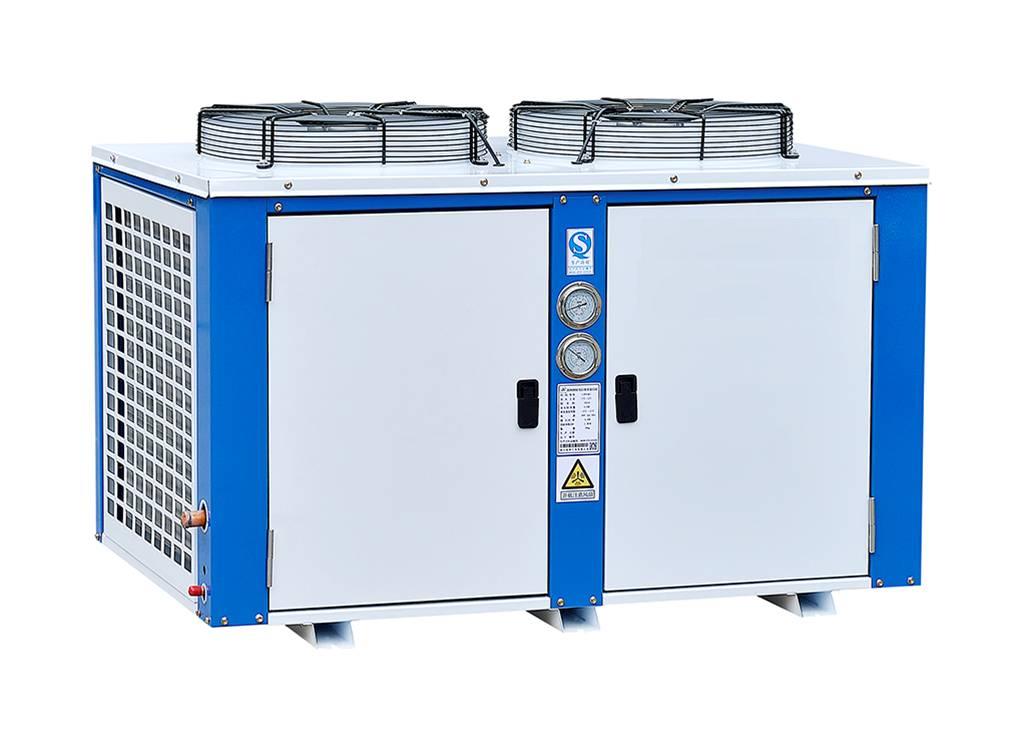
When configuring a small cooling facility, the physical footprint acts as a major constraint. Buyers generally choose between traditional open-frame split systems and modern enclosed configurations.
A Box Type design, often called a packaged unit, encloses the compressor, condenser, and controls within a single weather-resistant housing. The primary benefit is its compact footprint and streamlined installation. The internal piping is completed and pressure-tested at the factory. This drastically reduces the risk of field-brazing micro-leaks. For urban restaurants or retail stores with limited square footage, this air-cooled setup cuts installation complexity and upfront labor costs.
In contrast, traditional remote split systems separate the compressor from the condenser. Sometimes they place the entire assembly far away on a commercial rooftop. Remote systems offer flexibility in heat dissipation and indoor noise reduction. However, they require extensive copper piping runs, complex wiring, and a higher volume of refrigerant. This makes them far less practical for budget-conscious, small-scale applications.
The choice of refrigerant directly impacts volumetric efficiency and operating pressures. For decades, R404A has been the undisputed standard for medium and low-temperature preservation. Its performance characteristics make it highly suitable for these environments. Some legacy systems still utilize R22, but modern replacements heavily favor R404A for deep freezing.
This specific gas offers excellent thermal efficiency and a high cooling capacity per cubic foot of vapor. It provides highly reliable temperature control even under heavy, fluctuating product loads. Furthermore, its low discharge temperature helps protect internal compressor valves from thermal degradation during extended cycles.
The commercial sector is currently undergoing a massive transitional phase. While this gas is exceptionally effective mechanically, technicians must adhere to strict safety and recovery protocols. Proper handling ensures environmental compliance and system longevity.
The longevity of your environment relies heavily on the build quality of internal components. Since the compressor is the most expensive part to replace, selecting the right type is paramount. For small capacities, hermetic scroll compressors deliver whisper-quiet operation, fewer moving parts, and high volumetric efficiency. Semi-hermetic reciprocating compressors appear in slightly larger applications because technicians can rebuild and service them.
Condenser coil materials also dictate durability. Standard coils use copper tubes paired with aluminum fins. Specifically, if your facility sits in a coastal area with high atmospheric salt, you must specify epoxy-coated fins. This specialized treatment prevents rapid galvanic corrosion. It ensures the system maintains heat transfer capabilities over the years.
Additionally, modern units feature integrated control systems. Smart controllers with advanced diagnostics allow managers to monitor pressure metrics in real-time. You can log temperature fluctuations and receive automated alerts long before a minor electrical issue escalates into catastrophic failure.
As a refrigeration engineer, I often see business owners make a critical mistake. They evaluate a system solely on its initial purchase price. The Total Cost of Ownership encompasses the upfront capital expenditure plus electricity and maintenance costs over a 10-year lifespan. A cheaper, inefficient unit quickly consumes its initial savings through inflated monthly utility bills.
Energy efficiency depends heavily on ambient temperatures. If the outdoor machinery sits in a poorly ventilated mechanical room, ambient air temperature artificially rises. This forces the compressor to work exceptionally hard to reject heat. It inevitably increases power consumption and reduces the Coefficient of Performance.
To maintain baseline efficiency, proper ventilation is non-negotiable. Keeping the condenser coil clean from dust, kitchen grease, and fallen leaves ensures optimal airflow. In field applications, a blocked coil acts like a thick insulating blanket. It forces the system to operate at abnormally high condensing pressures. This spikes electricity usage and frequently triggers high-pressure safety switch lockouts.
Even the highest-tier equipment fails prematurely if installed incorrectly. Professional installation by certified technicians is mandatory. Copper lines must be properly brazed, pressure-tested with oxygen-free nitrogen, and evacuated with a micron gauge. This removes all non-condensable gases and moisture. Moisture left inside a refrigeration circuit reacts with compressor oil to form harsh acids. These acids silently destroy motor windings over time.
Once operational, adhere to a strict routine maintenance checklist:
Monthly: Inspect the condenser coil for debris and clean with a non-acidic foaming cleaner. Check for unusual vibrations.
Quarterly: Verify the operation of condenser fan motors. Listen for unusual bearing noises. Ensure the ambient area remains clear of obstructions.
Bi-Annually: Have a technician check refrigerant superheat and subcooling levels. Inspect electrical contactors for pitting or burn marks.
Troubleshooting early signs of a struggling system saves thousands of dollars in emergency repair fees. Look out for thick ice formation on the suction line or erratic clicking noises from the contactor.
Every commercial facility has unique spatial and thermal constraints. Standard off-the-shelf units may not perfectly align with specific door-opening frequencies or rapid product pull-down requirements. In these instances, seeking suppliers who offer customizable configurations is highly recommended.
Assessing supplier credibility is just as important as evaluating the hardware. A reputable manufacturer provides comprehensive engineering data, clear warranty terms, and accessible technical support. When building your Cold Storage, look for manufacturers that deliver reliable machinery tailored to commercial applications. Quick access to replacement parts and troubleshooting guidance minimizes expensive downtime.
Standardizing equipment across multiple cold rooms is an effective strategy. By utilizing the same brand and model series, your maintenance team streamlines spare parts inventory. Critical components like contactors, fan blades, and pressure switches remain on hand for immediate replacement.
Choosing the right machinery for small-scale preservation is a delicate balance of technical calculation and practical planning. Focus on your specific thermal requirements. Opt for high-quality components and consider the streamlined installation provided by enclosed designs. Investing time in the selection phase acts as the best insurance policy for your inventory and bottom line. Ready to upgrade your facility? Evaluate your daily operational needs and explore the robust, energy-efficient solutions from Retekool to guarantee long-term success for your business.
You should conduct a comprehensive thermal heat load calculation that accounts for the exact volume of the room, the insulation value of the panels, the maximum ambient temperature of the installation site, and the specific heat of the products you are storing. If you are not entirely sure how to perform these calculations, consulting a licensed refrigeration engineer prevents catastrophic system failure and product spoilage.
This refrigerant is highly reliable, thermally stable, and exceptionally efficient for many small preservation applications. This is exactly why it has been an industry standard for decades. However, you must verify your local and national environmental regulations. Some regions are actively phasing out certain gases in favor of newer alternatives. Always plan for the long-term compliance of your facility.
An enclosed, packaged unit is designed as a single, fully integrated mechanical assembly. Because the components are housed together in a weather-resistant casing, it minimizes the need for extensive field piping work. This significantly reduces the risk of refrigerant leaks and makes it much faster to install in small rooms compared to sprawling split systems.
Air-cooled systems use a fan to blow ambient air across the condenser coil to remove heat. They are easier to install and maintain, making them ideal for small facilities. Water-cooled systems use a liquid cooling loop and a cooling tower to reject heat. While water-cooled systems are highly efficient in extreme ambient temperatures, they require complex plumbing and regular water treatment, which adds significant maintenance overhead.
Ice formation on the outdoor machinery usually indicates a severe airflow restriction or a refrigerant issue. A dirty evaporator coil, a failed indoor fan motor, or a clogged air filter prevents heat from absorbing into the system. This drops the suction pressure and causes moisture to freeze on the copper lines. Alternatively, a low refrigerant charge due to a micro-leak can also cause the system to freeze. Both scenarios require immediate technical diagnosis.
For optimal thermodynamic performance and to extend mechanical life, visually inspect and clean the condenser coils every three to six months. Facilities located in dusty, greasy, or highly industrial environments require strict monthly cleanings to prevent high-pressure safety lockouts.
It is highly risky and generally not recommended. The outdoor machinery must be perfectly thermodynamically balanced with the evaporator coil inside the insulated room. If they are not matched properly, your system experiences severe operational issues. It either fails to cool the space effectively or suffers from liquid slugging. Liquid slugging causes catastrophic and irreversible damage to the compressor valves.


