 English
Views: 0 Author: Site Editor Publish Time: 2026-09-25 Origin: Site


Did you know uneven cooling silently destroys compressor lifespans? Hot spots within a refrigeration system waste energy, severely ruin appliance efficiency, and compromise product safety. As engineers, solving this thermodynamic puzzle requires mastering thermal flow distribution.
Recent shifts in the global thermal management industry reveal a massive regulatory push toward high-efficiency, low-GWP (Global Warming Potential) refrigeration systems. The phase-down of legacy hydrofluorocarbons (HFCs) under international agreements has forced manufacturers to pivot to eco-friendly, natural refrigerants like R290 and R600a. Because these refrigerants operate under different thermodynamic profiles and pressure demands, mastering heat transfer is no longer just an engineering preference—it is a strict compliance necessity. In this comprehensive guide, we will break down exactly how channel layout and metal thickness work together to ensure flawless cooling uniformity.
Channel Pattern Dictates Flow: Serpentine pathways offer higher refrigerant velocity and superior heat transfer rates but come with higher pressure drops. Parallel flow patterns provide better fluid distribution for larger surface areas but require precise balancing to avoid starvation.
Thickness is a Balancing Act: Thinner aluminum plates reduce thermal resistance for faster cooling response times. Conversely, thicker plates provide the essential structural integrity needed to handle high-pressure refrigerants while improving lateral heat spreading.
Synergy is Crucial: Achieving ultimate cooling uniformity, especially at critical low temperatures like -18°C, relies entirely on matching specific channel widths with the appropriate aluminum plate thickness.
Application Specificity: The thermodynamic requirements for a standard domestic appliance differ significantly from those of a high-demand commercial unit or a liquid cold plate used in high-density electronics cooling.
To optimize thermal management systems, you must first dissect the structural and material fundamentals of the components you are designing. The roll bonding process is a highly specialized manufacturing technique. It yields extremely efficient heat exchangers used across multiple demanding industries.
Manufacturing an aluminum roll bond evaporator isn't just basic metalwork; it is a highly controlled metallurgical process. The procedure begins with two separate sheets of high-grade aluminum. A specific channel pattern is silk-screened onto one of the sheets using a specialized graphite-based stop-weld ink. Next, these two sheets are stacked and passed through a massive rolling mill under immense heat and pressure.
This intense compression metallurgically welds the two aluminum sheets together into a single, solid plate. The only exceptions are the exact areas where the stop-weld ink was applied. Finally, high-pressure fluid or air is injected into these unbonded pathways. This inflates them to create the internal channels where the refrigerant will eventually flow. Aluminum remains the universal choice for this process due to its exceptional thermal conductivity (approximately 205 W/m·K), high malleability, and natural corrosion resistance.
Historically, this technology has been the invisible backbone of the domestic appliance industry. It is most frequently deployed as a refrigerator evaporator, where it forms the internal cooling walls. You will also see it formed into C-shapes or O-shapes to entirely surround frozen compartments, maximizing surface contact.
Furthermore, the application of this technology has expanded rapidly beyond traditional kitchens. Automotive engineers now rely on roll-bonded cold plates for battery thermal management systems (BTMS) in electric vehicles. This ensures volatile lithium-ion cells remain within their optimal temperature window. Similarly, the data center industry utilizes these panels for liquid cooling high-density servers, where uniform heat extraction prevents catastrophic thermal throttling.
Cooling uniformity is not merely an aesthetic choice or a minor design preference. It is a strict thermodynamic requirement for long-term system reliability.
Cooling uniformity refers to the ability of a flat plate evaporator to maintain an identical temperature across every square inch of its surface. In a flawless system, the refrigerant absorbs latent heat evenly as it undergoes a phase change from a low-pressure liquid to a gas.
When a system suffers from poor flow distribution, significant thermal gradients emerge. Imagine a commercial display unit where certain sections of the backplate become excessively cold. This leads to localized freezing and severe frost buildup. Meanwhile, other areas remain noticeably warm. These "hot spots" indicate a major flaw: the refrigerant has either fully evaporated too early in the channel path, or the flow has bypassed that section entirely.
Think about the compressor—the mechanical heart of your system. When heat absorption is uneven, ambient cabinet temperatures drop sluggishly. The thermostat demands more, forcing the compressor into brutal, continuous duty cycles.
This extended run time drastically spikes energy consumption, lowering the appliance's Coefficient of Performance (COP). Worse still, the continuous mechanical strain accelerates wear and tear on the compressor's internal valves and motor. This practically guarantees an increase in premature field failures and expensive warranty claims.
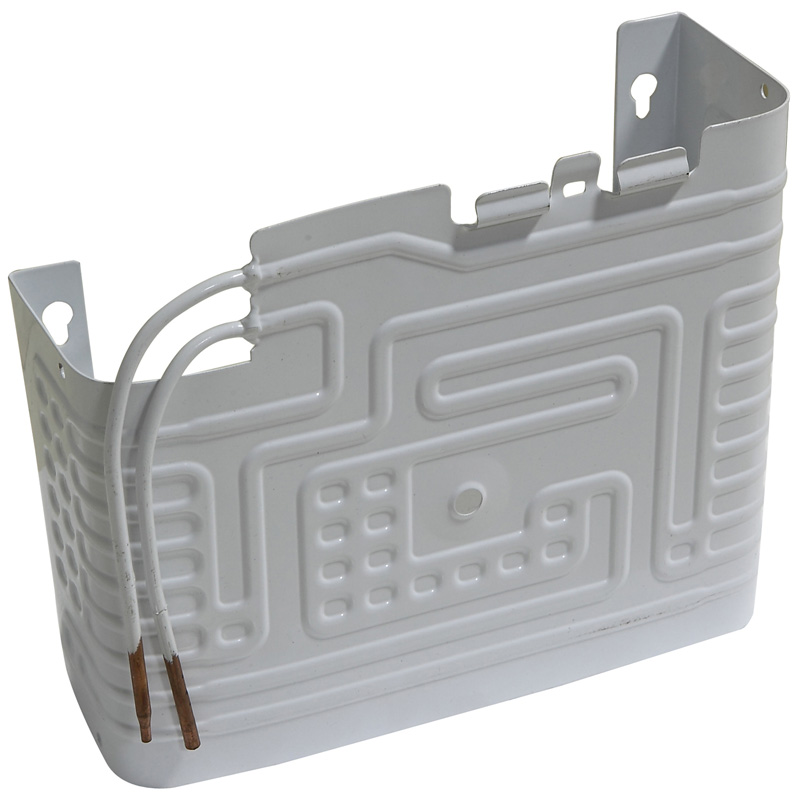
The pathway that the refrigerant takes as it travels through the metal plate is the single most critical factor in determining how evenly heat is absorbed. This is exactly where evaporator channel design transitions from a simple CAD drawing into complex, multi-phase fluid dynamics.
Engineers typically evaluate two primary flow architectures. Depending on the thermal load, they often settle on a hybrid of both.
Serpentine Channels: A serpentine pattern consists of a single, continuous winding path that zigzags back and forth across the plate. Because the entire volume of refrigerant is forced through this solitary channel, fluid velocity remains exceptionally high. This high velocity promotes turbulent flow, maximizing heat transfer and ensuring excellent oil return to the compressor. However, the long path results in a high frictional pressure drop. This can create an unavoidable temperature gradient between the inlet and the outlet.
Parallel Channels: In a parallel configuration, the incoming refrigerant is split into multiple distinct channels that run alongside each other before recombining at the exit. This design is phenomenal for covering large surface areas evenly and results in a significantly lower overall pressure drop. The inherent danger here is flow maldistribution. If the channels are not perfectly balanced, liquid refrigerant will favor the path of least resistance, starving other channels and creating severe warm zones.
Feature | Serpentine Pattern | Parallel Pattern |
|---|---|---|
Fluid Velocity | High | Low to Moderate |
Pressure Drop | High | Low |
Oil Return Efficiency | Excellent | Poor to Moderate |
Flow Distribution Risk | Low (Single path) | High (Risk of starvation) |
Beyond the macro-pattern, the exact width of the inflated channels directly impacts the two-phase refrigerant flow. Narrower channels, such as an 8mm width, restrict the flow area and force an increase in velocity. This induces turbulence, constantly mixing the liquid and gas phases. It prevents an insulating vapor film from forming against the channel wall. The trade-off is an exponential increase in frictional resistance.
In contrast, wider channels (e.g., 12mm) lower the pressure drop, allowing the refrigerant to maintain a consistent saturation temperature. However, if the velocity drops too low in horizontal orientations, phase separation occurs. The heavier liquid pools at the bottom while the lighter gas flows over it. Because the gas phase absorbs very little heat, this severely degrades cooling uniformity.
Navigating pressure drop is a delicate balancing act. If the pressure drop is too aggressive, the refrigerant boils off too early, leaving the latter half of the panel starved. If the pressure drop is too low, the refrigerant may not fully evaporate, risking catastrophic liquid slugging in the compressor.
While internal geometry dictates fluid behavior, the thickness of the aluminum plate governs how heat is conducted from the external environment into the refrigerant. Selecting the right gauge is always an engineering compromise between thermal responsiveness and raw structural integrity.
According to Fourier’s Law, the rate of heat transfer through a material is inversely proportional to its thickness. Thinner aluminum plates naturally offer lower thermal resistance. When the compressor cycles on, a thinner plate drops in temperature almost instantaneously. This provides rapid transient cooling to the appliance interior. Yet, designing a plate solely for minimum thermal resistance ignores critical mechanical realities.
These panels cannot be made infinitely thin. The internal channels act as miniature pressure vessels. Modern refrigerants like R600a (isobutane) and R290 (propane) have distinct and often demanding operating pressures. Imagine a system sitting idle during a hot summer day; the internal pressure equalizes and rises significantly. Thicker aluminum plates provide the necessary tensile strength to withstand these spikes without ballooning or rupturing. The burst pressure margin is a non-negotiable safety metric.
In the appliance manufacturing sector, the total bonded thickness typically ranges from 1.2mm to 2.0mm. For standard domestic units utilizing low-pressure refrigerants, a thinner profile (1.2mm - 1.5mm) provides excellent heat transfer while saving material costs. However, for heavy-duty commercial systems, engineers frequently specify thicker plates (1.5mm - 2.0mm+) to prevent fatigue failures caused by continuous pressure cycling over a 10-to-15-year lifespan.
Understanding these variables in isolation is only half the equation. True engineering mastery lies in harmonizing channel patterns and plate thickness to achieve specific goals in extreme environments.
Designing a freezer evaporator presents unique hurdles. The system must hit a strict -18°C uniformly to prevent localized thawing, which ruins food texture and safety. At these sub-zero temperatures, frost bridging is a major threat. If channels are poorly spaced, heavy frost builds up directly over the pathways while gaps remain clear, acting as an insulator.
To combat this, engineers utilize a hybrid parallel-serpentine pattern alongside optimized plate thickness. The parallel sections distribute liquid across the entire width of the freezer wall. Simultaneously, serpentine exits maintain enough velocity to prevent oil logging.
The flat aluminum areas between the inflated channels act as extended fins. If the plate is too thin, the thermal resistance of the metal prevents the cold from spreading laterally. This results in distinct cold lines and warm gaps. By strategically increasing the plate thickness, engineers increase the cross-sectional area for heat conduction. This thicker metal effectively "spreads" the cold laterally, bridging the gaps and creating a flawlessly uniform surface temperature.
Transitioning a highly optimized thermal management design from theoretical models into a physical product requires strategic foresight. Abstract principles must translate into concrete manufacturing specs.
For Chest Freezers: Opt for a double-sided inflated design. An aluminum plate thickness around 1.5mm ensures structural integrity under heavy frost loads. Ensure capillary tubes are seamlessly integrated using robust copper-to-aluminum joints protected by heat shrink tubes to prevent galvanic corrosion.
For Upright Display Fridges: Single-sided inflation with a flat back is ideal for maximizing interior space. A standard 1.2mm plate thickness is usually sufficient. To prevent oxidation in high-humidity commercial environments, specify a white electrostatic epoxy powder coating (typically 60-90 microns thick).
Utilizing CFD Simulation: Before cutting expensive physical molds, industry leaders employ Computational Fluid Dynamics (CFD) software. Simulating the two-phase flow allows engineers to visualize temperature gradients, predict pressure drops, and tweak channel widths virtually.
Achieving perfect cooling uniformity is never an accident. It is the calculated result of harmonizing complex thermodynamic variables. Engineers must carefully balance internal channel patterns—weighing the velocity of serpentine flows against the broad coverage of parallel designs—with the precise thickness of the aluminum plate. This synergy ensures efficient heat transfer, prevents compressor burnout, and maximizes the operational lifespan of the appliance.
Ready to eliminate thermal hot spots and upgrade your refrigeration system's efficiency? Don't leave your thermodynamic performance to chance. Explore our full range of customizable, high-performance components and find the exact match for your project at Retekool. Whether you need a standard flat plate or a complex, multi-bend freezer module, our engineering team is ready to deliver precision-manufactured solutions tailored to your specific thermal loads.
A: There is no single "perfect" pattern, as efficiency depends heavily on the specific dimensions and thermal load. However, empirical data suggests a hybrid design—utilizing a primary serpentine path that branches into carefully calibrated parallel sub-channels—often yields the best results. This maintains refrigerant velocity for oil return while distributing the cooling effect evenly to maintain a strict -18°C.
A: Cost is directly proportional to the volume of raw aluminum required. Thicker plates consume more material and require more energy during the hot rolling process, increasing the baseline cost. However, arbitrarily reducing thickness to save pennies can compromise burst pressure limits, leading to catastrophic field failures—especially with high-pressure refrigerants like R290.
A: Absolutely. The fundamental principles of roll bond technology are highly transferable. These plates are increasingly utilized as liquid cold plates for high-density power electronics, data center servers, and EV battery packs. The design focus simply shifts toward minimizing liquid pressure drop while maximizing surface contact with heat-generating components.
A: Aluminum offers a unique combination of physical properties: high thermal conductivity (around 205 W/m·K) for rapid heat absorption, an excellent strength-to-weight ratio, and high malleability. This ductility is critical for surviving the extreme deformation of the heavy reduction rolling process and subsequent high-pressure inflation. It is also significantly more cost-effective than copper.
A: Maldistribution occurs when refrigerant does not divide equally among paths, typically caused by uneven pressure drops. Contributing factors include microscopic variations in channel width due to inconsistent inflation, poor inlet manifold design, or gravity affecting the liquid-vapor mixture in vertical orientations. This leads to severe temperature gradients and localized hot spots.
A: In humid environments or systems with frequent defrost cycles, raw aluminum oxidizes easily. Applying a specialized white electrostatic epoxy powder coating is standard practice. This coating must be microscopically thin (typically 60-90 microns) so it doesn't act as a thermal insulator, while still providing robust rust protection and a clean aesthetic finish.
A: Burst pressure depends heavily on the specific channel width and the overall plate thickness. However, a properly manufactured unit utilizing 1.2mm to 1.5mm aluminum plates should comfortably handle the standard operating pressures of modern refrigerants like R600a and R290. Quality components are often factory-tested to withstand internal pressures exceeding 1.5 MPa to 2.0 MPa before failure.


