 English
Views: 1 Author: Site Editor Publish Time: 2026-07-17 Origin: Site


Procurement and engineering teams face high stakes when building modern refrigeration systems. Selecting the wrong heat exchange component can lead to catastrophic failures down the line. Poor thermal efficiency, localized corrosion, and costly refrigerant leaks are common outcomes of improper selection. Bridging the gap between strict thermodynamic requirements and actual manufacturing realities is essential for success. Engineers need components capable of handling precise pressures. Buyers require reliable, scalable supply chains. A rigorous technical and commercial evaluation prevents design bottlenecks while ensuring long-term appliance performance.
A reliable choice always requires balancing channel design, material integrity, and the manufacturer's quality control capabilities. This guide explores how you can evaluate these critical factors systematically. We will walk you through spatial planning, coating evaluations, tooling considerations, and defect mitigation strategies. You will learn actionable steps to make an informed, data-backed choice.
Profile matching is critical: Choosing between single-sided and double-sided inflation dictates both contact efficiency and structural rigidity.
Coating dictates lifespan: Powder coating quality and strict salt-spray testing are non-negotiable for corrosion resistance.
Quality control beats unit cost: Supplier selection must prioritize 100% helium leak testing to mitigate assembly-line defect rates.
Tooling ROI: Custom channel designs require careful volume forecasting to amortize upfront tooling costs effectively.
You cannot select an optimal component without first mapping your baseline thermodynamic needs. System design dictates every physical parameter of your heat exchanger. Engineers must calculate thermal loads accurately before reviewing any manufacturing catalogs.
Your primary goal is mapping the required heat exchange rate to the surface area of the roll bond evaporator plate. Thermodynamics requires sufficient surface contact to absorb heat from the surrounding environment. If you specify a plate too small, the compressor will overwork. This leads to premature system failure. If you specify one too large, you waste internal cabin space and materials. Always calculate the target wattage required to cool your specific volume of air or liquid. Use these calculations to determine the exact dimensions and channel density.
Different cooling applications demand entirely different structural parameters. You must define the environment where the equipment will operate.
Domestic Refrigerators: These require compact footprints and silent operation. Flat designs maximize shelf space.
Commercial Showcase Freezers: These units demand high cooling capacities. They face frequent door openings and high ambient temperatures.
Medical Cold Storage: Vaccine and blood storage demand absolute temperature stability. Channel designs here prioritize rapid, uniform cooling distribution.
Battery Thermal Management: Emerging EV and energy storage applications need customized shapes. These plates often wrap around cylindrical battery cells to prevent thermal runaway.
You must confirm pressure limits based on your specific refrigerant. Different gases operate at vastly different internal pressures. For example, R600a (isobutane) and R290 (propane) are highly efficient but flammable. They require strict safety margins regarding burst pressure. R134a operates under different pressure thresholds entirely. You must ensure your specified burst pressure safely exceeds the maximum operating pressure of your chosen refrigerant. Overlooking this detail invites catastrophic field failures.
Manufacturers create channels by inflating aluminum plates under high pressure. The inflation method you choose directly impacts both performance and physical integration. You must align the inflation profile to your specific cooling strategy.
Single-sided inflation creates channels on one side while leaving the other side perfectly flat. We see this design frequently in direct contact cooling applications. Examples include integrated freezer shelves or hidden cold walls inside domestic appliances.
The primary advantage here is thermal conduction. The perfectly flat surface allows maximum physical contact between the Roll Bond Evaporator and the target object. When a flat shelf touches a frozen product directly, heat transfers much faster than through the air. However, manufacturing a perfectly flat side requires specialized tooling. This can sometimes increase production complexity.
Double-sided inflation allows the internal channels to bulge outward on both sides of the plate. This creates a symmetrical profile. We recommend this profile for convective cooling environments. If your design uses a fan to blow air across the plate, double-sided designs work exceptionally well.
The main advantage is higher structural rigidity. The bilateral channels act like reinforcing ribs. This makes the entire plate stiffer and less prone to bending during assembly. Additionally, double-sided designs often feature lower tooling complexity. They are highly efficient for open-air showcase coolers where direct contact is unnecessary.
You must evaluate the trade-off between physical space constraints and required flow dynamics. Use the following chart to guide your selection.
Inflation Type | Best Application | Primary Advantage | Common Use Case |
|---|---|---|---|
Single-Sided | Direct Contact Cooling | Maximum flat surface area for conduction | Freezer shelves, inner cold walls |
Double-Sided | Convective Cooling | Enhanced structural rigidity, easier tooling | Display coolers, open-air evaporators |
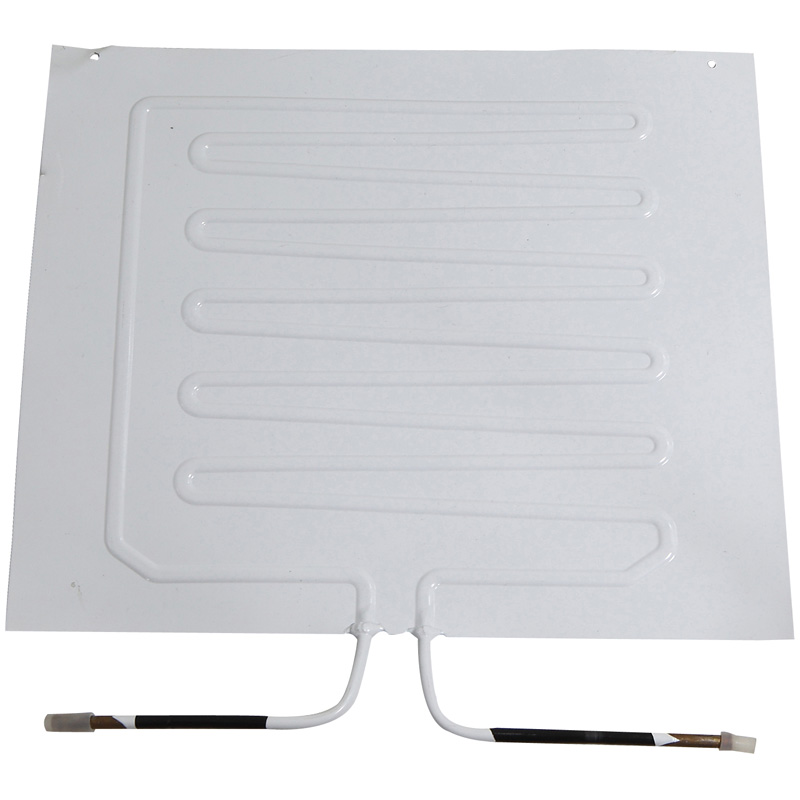
Material integrity determines how long your appliance will last in the field. Aluminum provides excellent thermal conductivity. However, it remains vulnerable to environmental degradation if left untreated. You must specify exact grades and coatings.
Industry standards typically dictate the use of 1060 or 1070 series aluminum. These specific grades offer the optimal balance of formability and thermal conductivity. They allow the metal to stretch during the high-pressure inflation process without tearing. The 1070 grade boasts slightly higher purity. This yields marginally better heat transfer rates. We advise against accepting lower-grade alloys. Impurities in the metal can cause micro-fissures during inflation.
Plate thickness impacts both burst pressure resistance and overall unit weight. Manufacturers start with pre-rolling thickness. After the plates bond under extreme pressure, the post-rolling thickness emerges. You must specify minimum wall thickness for the inflated channels. A channel wall that is too thin will fail under high refrigerant pressure. A wall that is too thick will insulate the refrigerant, dropping thermal efficiency. Precise micrometer tolerances guarantee consistent performance across large production batches.
Untreated aluminum oxidizes rapidly when exposed to condensation. You must demand high-quality surface treatments. Epoxy powder coating and anodizing represent the industry standard defenses. When evaluating suppliers, you should request verifiable data.
Coating Adhesion: Demand cross-hatch testing results to prove the powder coating will not flake.
Salt-Spray Testing: Require a minimum number of salt-spray hours (often 500+ hours). This ensures longevity in high-humidity environments.
Edge Coverage: Ensure the coating wraps completely around the punched edges of the plate. Raw edges invite galvanic corrosion.
Moving from a theoretical CAD drawing to mass production involves significant engineering hurdles. You must weigh the benefits of custom geometry against the realities of factory scaling. Managing this transition dictates your project timeline.
You must decide when to invest in custom channel printing. Standard, off-the-shelf designs work well for basic rectangular freezers. They require zero upfront development delays. However, specialized appliances often demand custom routing. If you need specific cutouts for lighting, fans, or irregular cabin shapes, custom printing is mandatory. Custom designs allow engineers to optimize the pressure drop across the entire plate. This maximizes compressor efficiency.
Creating new printing screens and inflation dies requires an initial investment. You must forecast your projected production volumes carefully. Calculate the return on investment by spreading this tooling expense across your first major production run. High-volume orders easily absorb custom tooling expenses. For low-volume niche products, modifying a standard plate geometry might prove more prudent. Always discuss tooling ownership rights before signing a contract.
Realistic timelines prevent assembly line stalls. A typical timeline follows a strict sequence:
CAD Design and Review: Requires intensive engineering collaboration. Typically takes one week.
Prototype Tooling and Inflation: Manufacturers create initial printing screens. Expect two to three weeks.
Performance Testing: The prototype undergoes burst and thermal testing. This takes roughly one week.
Full-Scale Production Rollout: Once approved, raw material procurement and mass production begin. Plan for an additional four weeks.
Anticipate these cycles early. Rushing the prototype phase often results in sub-optimal channel flow.
Your component is only as reliable as the factory producing it. A poorly managed supply chain ruins excellent engineering. You must audit potential partners across several distinct operational categories.
Refrigerant leaks destroy brand reputation. You must reject suppliers relying solely on outdated water-bath testing. Submerging plates in water and looking for bubbles is highly inaccurate. It routinely misses microscopic pinholes. You must insist on automated 100% helium leak detection. Helium atoms are incredibly small. They escape through micro-fissures water cannot penetrate. Factories utilizing vacuum helium mass spectrometry demonstrate true commitment to defect mitigation. This single requirement drastically reduces assembly-line defect rates.
Never take a supplier's quality claims at face value. You must verify their certifications. Ensure the facility holds an active ISO 9001 certification for quality management. Furthermore, verify environmental compliance. The materials must meet RoHS and REACH standards. This guarantees no hazardous substances exist in the coatings or base metals. Compliance ensures your final appliance can ship globally without customs delays.
Evaluate a supplier's ability to grow alongside your business. Investigate their raw material sourcing networks. Do they rely on a single aluminum mill? If so, material shortages could halt your production. Check their monthly yield capacity. Ensure their standard output exceeds your maximum seasonal demand. Finally, negotiate clear Minimum Order Quantities (MOQs). Flexible MOQs allow you to scale up gradually without hoarding unnecessary inventory.
Excellent manufacturing means nothing if the component arrives damaged. You must assess their global shipping protocols. These plates are relatively thin and prone to bending during transit. The attached copper or aluminum capillary tubes are highly fragile. Snapped tubes render the entire unit useless. Demand robust packaging solutions. Factories should use reinforced wooden crates. They must employ desiccant packs to prevent moisture ingress. Clear logistics planning guarantees pristine components upon arrival.
Finding the correct heat exchange component requires careful alignment of several disciplines. The right selection is a synergy of thermal design, precise inflation engineering, and rigorous leak prevention. You must define your spatial limits clearly before choosing an inflation profile. Material specifications, particularly powder coating durability, dictate the long-term survival of the appliance. Furthermore, adopting strict vetting procedures for manufacturers shields your assembly line from catastrophic delays.
Reiterate that partnering with a transparent, compliance-focused manufacturer yields superior long-term appliance reliability than chasing the lowest per-unit price. An investment in quality control upfront prevents costly field failures later. Protect your brand by prioritizing helium leak testing and premium aluminum alloys.
Take the next step in your design process today. Contact an experienced engineering team. Share your CAD drawings and thermodynamic specifications for a comprehensive feasibility review. Secure a detailed custom tooling estimate to keep your project moving forward.
A: Typical burst pressure limits range between 3.5 MPa and 8.0 MPa, depending on the design. These thresholds rely heavily on aluminum wall thickness and channel width. Wider channels generally exhibit lower burst pressure limits. You must select specifications that provide a safe margin above your refrigerant's maximum operating pressure.
A: Yes, they can physically function as condensers, but they require specific modifications. Evaporation and condensation involve distinct thermodynamic and pressure variables. Condensers typically operate at much higher internal pressures. You must specify thicker aluminum walls and narrower channel profiles to handle condensing applications safely.
A: Developing a custom prototype typically takes between three to six weeks. This timeframe covers initial CAD drawing approval, tooling creation, and sample production. Complex geometries or specialized capillary tube routing may extend this timeline slightly. Always factor this prototyping window into your broader project schedule.
A: Localized corrosion usually stems from manufacturing defects or installation errors. Common culprits include insufficient powder coating thickness and pinholes in the surface treatment. Galvanic corrosion also occurs frequently when improper metal coupling happens at the connection joints, such as joining copper to aluminum without proper heat-shrink sealing.


